
Build Your Own M3U Playlist
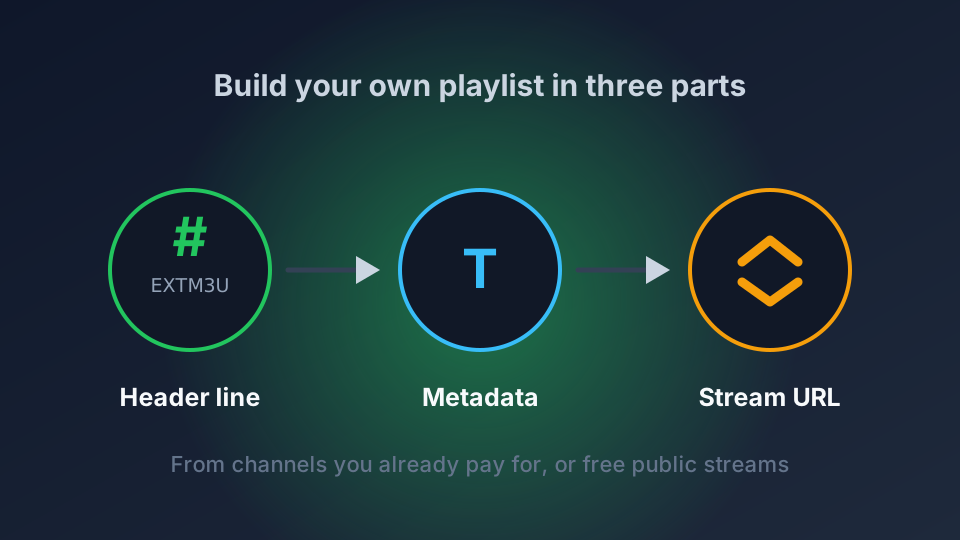
An M3U is a text file, so building one needs no technical skill — just the right three lines and sources you are entitled to watch.
Building your own M3U playlist sounds like it needs technical skill. It does not. An M3U is a text file, and assembling one is a matter of copying channel addresses into the right order. Done properly it also solves a real problem: it gives you one tidy, working list instead of three half-broken ones, and it keeps working when your provider's app changes.
This guide shows you exactly how to build one, what to put in it, and the rules worth keeping so you are not doing it again next month. Everything here uses sources you already pay for or that are free to watch.
What You Need Before You Start
Three things, and nothing exotic. A text editor — Notepad on Windows, TextEdit on Mac (in plain text mode), or any code editor like VS Code if you have one. A player to test the result in; IPTV Smarters Pro or VLC both load a local file easily. And a source of legitimate stream addresses. That last part is the one that matters, so read the next section carefully.
Where to Get Legitimate Stream Addresses
This is the only hard rule in this guide: only put streams in your playlist that you are entitled to watch. There are three reliable sources.
Your own provider. If you already pay for a service, its dashboard or app can usually show you the playlist address, and you can add your own channels around it.
Free-to-air and public streams. Many public broadcasters and community services publish open stream links. The cleanest starting point is our guide to free legal live TV apps, which lists services built specifically for free, licensed viewing.
Your own media. If you have TV shows or films you already own, tools exist that make your own local library watchable as channels. That is entirely your own content, so it is entirely legitimate.
What to avoid: playlists of thousands of channels offered for free with no explanation of where the streams come from. See the IPTV legality guide for why that is the wrong path — and the nine markers of an IPTV scam for what those offers usually are underneath.
The Three Lines That Matter
Every channel in an M3U playlist is a pair of lines. Getting these right is the whole skill.
Line 1 — the header. The very first line of the file must be #EXTM3U. One line, exactly, at the top. Players often refuse a file that is missing it, which is one of the most common reasons a hand-built playlist will not load.
Line 2 — the channel description. For each channel, a line starting with #EXTINF. The -1 that follows is a duration marker players ignore for live channels. After it, you can add metadata in any order, and two of them are worth knowing:
group-title="Sport" decides which folder the channel lands in — without it everything ends up in one untidy list. tvg-id="sports.example.tv" is the ID your EPG uses to match guide data to the channel; a correct ID is what makes programme listings appear automatically. Our EPG guide explains matching in more detail if you want listings rather than just video.
Line 3 — the stream address. The URL of the actual stream, directly underneath its description, on its own line. This is the line that must be copied perfectly. One missing character is the single most common reason a channel shows a black screen.
A Complete Working Example
Here is a tiny, valid playlist with two channels. Copy this into a text editor to see the shape of it:
#EXTM3U

          #EXTINF:-1 tvg-id="news.example.tv" tvg-name="Example News" group-title="News" tvg-logo="https://example.com/news.png",Example News HD

          https://example.com/live/news/720p.m3u8

          #EXTINF:-1 tvg-id="sport.example.tv" tvg-name="Example Sport" group-title="Sport" tvg-logo="https://example.com/sport.png",Example Sport HD

          https://example.com/live/sport/1080p.m3u8
Save it as my-playlist.m3u. Note the structure: header, then for every channel a description line followed by its URL, with nothing in between. Getting a blank line in the wrong place is a common mistake — some players skip the channel after it.
Saving and Loading It
Save the file with the extension .m3u or .m3u8. Two saving pitfalls catch people out. If your editor is set to hide file extensions, "my-playlist" becomes "my-playlist.txt" and the player will not recognise it — when saving, choose "All Files" so the extension is exactly what you typed. And on Windows, saving as plain text rather than Unicode keeps other players happy.
Then in your player, choose to add a playlist and select "Choose File" instead of entering a URL, and point it at the saved file. Test three channels — not just the first one — because a single working channel does not prove the rest of the addresses were copied correctly.
Keeping It Working
Stream addresses go stale. Broadcasters change servers, and links that worked last month quietly stop. The fix is a playlist health check: paste the file in, and it tells you which channels are dead, which are duplicated, and which are duplicates of each other. Then use our guide to programme guides and channel matching to get correct listings on the channels you keep, and compare the best IPTV players for the tools that can flag dead links for you.
One habit worth forming: keep a note of where each stream address came from. When a channel dies in six months, knowing it came from a free public stream rather than your provider tells you where to look for a replacement.
Conclusion
Building an M3U playlist is three parts — a #EXTM3U header, an #EXTINF line with a group title, and the stream URL — repeated for every channel. Keep it to sources you are entitled to watch, check it loads, and you have one tidy playlist that works across every player. Start with a couple of channels, get those working, then add more.
Never used IPTV before? The beginner's guide to IPTV covers the basics, and free versus paid IPTV is the honest comparison before you spend anything.